
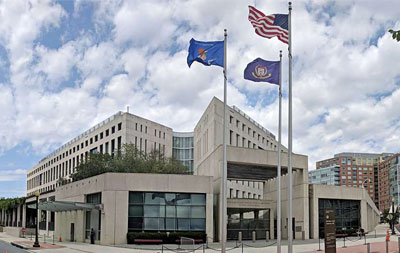
The Bureau of Alcohol, Tobacco, Firearms, and Explosives (ATF) published an interim final rule (IFR) last week ahead of a potentially landmark case before the U.S. Supreme Court.
This comes as state and local governments radically change how they regulate marijuana. It also predates the challenge to the current system that lumps all who use drugs in the same category, whether they are merely occasional imbibers or serious addicts.
Agency changed who is prohibited from possessing firearms as related to controlled substances
The ATF’s new IFR defines a “prohibited addict” as one “who uses a controlled substance and demonstrates a pattern of compulsively using the controlled substance, characterized by impaired control over use.”
The agency’s classification of a prohibited “unlawful user” also changed.
Now, it’s an individual “who regularly uses a controlled substance over an extended period of time continuing into the present, without a lawful prescription or in a manner substantially different from that prescribed by a licensed physician.”
ATF still believes a sober individual should be denied Second Amendment rights
The ATF rejected the idea that a person must be under the influence while engaged in Second Amendment-related activities. “A person may be an unlawful current user of a controlled substance even though the substance is not being used at the precise time the person seeks to acquire, ship, transport, receive, or possess the firearm.”
The rule then changes for one who occasionally partakes.
The agency said an individual “is not an unlawful user of a controlled substance if the person has ceased regularly unlawfully using the substance, or if the person’s unlawful use is isolated or sporadic or does not otherwise demonstrate a pattern of ongoing use.”
The high court last year granted certiorari in United States v. Hemani, a case that should bring optimism to the Second Amendment community that outdated laws will be changed.
It doesn’t, and here’s why.
The Department of Justice (DOJ) chose a suspected terrorist to trot out before the bench. Ali Danial Hemani is a dual citizen of the U.S. and Pakistan, and it was determined that he intended to support the Iranian Revolutionary Guard Corps.
A group designated as a foreign terrorist organization.
In 2020, Hemani and his family traveled to the Middle East to honor Qasem Soleimani, a general and powerful terrorist supporter who was taken out by a U.S. drone strike. His mother, on camera, expressed her desire for him and his brother to be martyred.
Hemani is also accused of being a drug dealer and a cocaine consumer. A real prince, the DOJ chose to present its case to the Supreme Court with this man as its star.
Despite the high-level charges surrounding the defendant, Hemani was only convicted of being an admitted marijuana user “every other day” while possessing a firearm and other drugs.
In United States v. Connelly, the Court wrote that “our history and tradition may support some limits on a presently intoxicated person’s right to carry a weapon…but they do not support disarming a sober person based solely on past substance usage.”
The Fifth Circuit further rejected the government’s contention that irregular drug users be lumped in with the “dangerous” or “mentally ill.” And while the government accepted that Connelly required the dismissal of Hemani’s conviction, it argued that the findings in the original case were wrong.
As for Hemani, government lawyers will undoubtedly portray him as a dangerous individual, and he may be.
But gun rights supporters argue that he should be convicted for other activities, not for being an occasional marijuana user who also possesses a firearm. And ATF Acting Director Daniel Driscoll admitted that the pending high court case could affect the agency’s definition.“ATF may reassess the definition of unlawful user in a separate notice of proposed rulemaking after the pending case United States v. Hemani concludes at the Supreme Court and considering any public comments in response to this IFR, or it may make amendments in a final rule based on this interim one,” Driscoll said.
There’s no better way to show your patriotism than with merch that speaks before you do.
Defend America is more than a name, it’s a stand for freedom, resilience, and the values this country was built on. Every tee, hat, and mug is a symbol of unapologetic pride. Wear it loud, wear it proud, and let the world know: freedom isn’t negotiable.
Click the link below to join the movement.